Yellow Ears? Lily Pollen vs. Jaundice: A Life-Saving Guide
A common confusion that costs lives. Why that "yellow stain" might be a medical emergency, not a liver problem.
Scenario: You come home to find a vase of lilies knocked over. Your cat looks completely normal, acting playful and hungry. But then you notice something odd—a bright yellow smudge on their ear or paw.
Your first thought might be, "Is that jaundice? Is their liver failing?"
Stop. This is likely not jaundice. It is Lily Pollen, and it is exponentially more urgent. Understanding the difference in the next 5 minutes could save your cat's life.
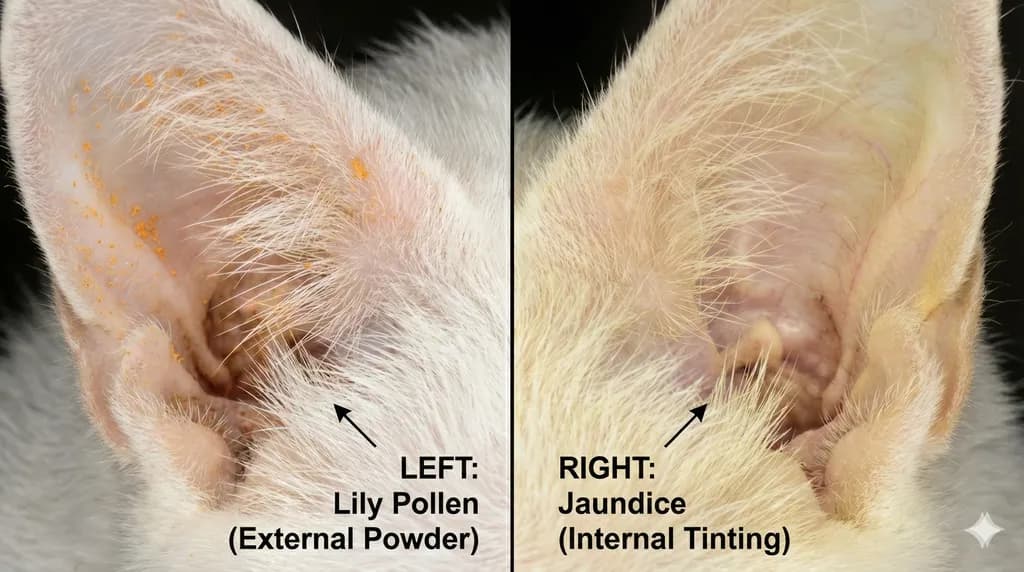
The Critical Difference
Lily Pollen
- Appearance:Bright, neon orange or yellow dust.
- Texture:Powdery, sticky, sits on top of fur.
- Location:Patches on nose, ears, paws, or chest.
- Target:Kidneys (Renal Failure).
Jaundice (Icterus)
- Appearance:Pale lemon yellow tint involved in skin.
- Texture:Not a substance; it is the skin color itself.
- Location:Whites of eyes, gums, inside ears.
- Target:Liver issues.
The 96-Hour Trap
The most terrifying aspect of Lily Poisoning is the "Latent Phase."
After ingesting pollen (often by grooming it off their fur), a cat might vomit once and then appear completely normal for 2-4 days.
During this "silent" time, the toxins are actively destroying the kidneys. By the time they show signs of illness again (kidney failure), it is often too late to treat.
Immediate Action Plan
1. Do NOT Wipe with a Wet Cloth
Water makes pollen sticky and harder to remove. Using a wet cloth can rub the toxin deeper into the fur or skin.
2. Do NOT Let Them Groom
This is critical. Put an E-Collar (cone) on immediately if you have one. If not, wrap the cat in a towel to prevent them from licking the powder.
3. GO TO THE VET
This is an emergency. The vet needs to perform decontamination (washing) and likely start IV fluids to flush the kidneys. Ask for a BUN/Creatinine blood test baseline.
Need to check toxicity level?
See the full designated safety guide for Lilies.